Furniture Delivery Service in India | Doorstep Furniture Pickup & Pan India Transport
Looking for a reliable furniture delivery service in India? We provide doorstep furniture pickup, professional packing, secure loading and Pan India furniture transport for sofas, beds, wardrobes, dining tables, office furniture and household items. Book your furniture pickup online with live tracking, GST billing and safe door to door delivery anywhere in India.
Why Choose This Furniture Delivery Service
Doorstep Pickup
No need to drop furniture anywhere — our team collects it directly from your home, office or showroom.
Professional Packing
Each piece is padded, wrapped and protected on-site before it's loaded, not packed carelessly at a depot.
Pan India Coverage
From nearby cities to the other end of the country, furniture is delivered through an established transport network.
Live Tracking
A tracking ID is issued at pickup, with status updates through to delivery.
GST Invoicing
Proper GST invoices for furniture shops, offices and businesses shipping regularly.
What Is a Furniture Delivery Service?
A furniture delivery service is a specialised courier and cargo service built specifically for moving furniture — items that are heavy, awkwardly shaped, often fragile, and simply don't fit through a standard courier's usual process of a customer bringing a sealed box to a counter. Instead, the service handles the entire journey: collecting the item from wherever it currently sits, packing it properly for the specific type of furniture it is, loading it securely, transporting it, and delivering it to the exact spot it needs to go — a flat on the fourth floor, an office cabin, a rented apartment in another city.
This is different from general courier or cargo services in a meaningful way. A courier service built for parcels and boxes assumes the sender has already packed the item appropriately. Furniture rarely arrives pre-packed in any useful sense — a dining table has no box, a sofa can't be taped shut, and a wardrobe often needs to be partially disassembled before it can travel safely at all. A dedicated furniture delivery service accounts for all of this from the first visit, rather than treating a sofa the same way it would treat a courier bag.
Why This Matters More Than People Expect
Furniture tends to be one of the more expensive and emotionally significant categories of household goods people ship — a family heirloom dining table, a sofa set bought after months of saving, an office desk that's been custom-fitted to a workspace. Damage during transit isn't just an inconvenience; it's often a genuine financial loss that's hard to reverse. That's exactly why the packing, loading and handling steps in a proper furniture delivery service are treated as core parts of the job, not an afterthought squeezed in before loading.
Furniture Delivery vs. a Regular Courier or Cargo Booking
It helps to be specific about where the line sits. A regular parcel courier is built around items the sender has already boxed and sealed — the courier's job starts and ends with pickup, transport and delivery of something that's already ready to travel. General cargo services, similarly, are usually built for goods that arrive palletised or crated, with the shipper responsible for how the load is prepared. Furniture delivery sits in a different category entirely: the item arrives unpacked, often needs partial disassembly, and requires judgment calls at the point of pickup about how best to protect it. A service that treats a sofa the way it would treat a sealed cardboard box is one where damage becomes a matter of when, not if.
Who Actually Needs Furniture Delivery Service
It isn't just for people moving house — here's the full range of situations this service covers.
Families Shifting Home
Moving from one apartment or society to another within a city, or to a different city entirely.
Students
Sending a study table or chair between hostels, or home at the end of a course.
Working Professionals
Relocating for a job and needing furniture to follow to the new city.
Businesses & Corporate Offices
Office relocation, branch setup, or moving desks and cabinets between locations.
Interior Designers
Moving custom or client-purchased furniture pieces between project sites.
Furniture Shops
Delivering purchased furniture to customers in another city, or moving stock between branches.
Rental Furniture Companies
Moving rented furniture between customers, cities or storage facilities.
People Sending Furniture to Another City
Gifting furniture, or simply not wanting to leave a good piece behind during a move.
Types of Furniture We Deliver
Household Furniture
The bulk of what moves through this service is everyday household furniture — the pieces that make a house feel like a home and that people are understandably reluctant to leave behind during a move. A sofa set that's been broken in just right, a dining table where a family actually gathers, a wardrobe that fits a room's specific layout — these aren't easily replaced with something bought fresh at the destination, which is exactly why so many people choose to ship them rather than start over.
Office & Commercial Furniture
Corporate relocations and office setups bring a different mix — furniture built for durability and repeated use rather than home comfort, often needing to be moved in coordinated batches rather than as single items. An office relocation rarely involves just one desk; it's usually a dozen workstations, several cabinets and a reception set, all needing to arrive at the new location on a similar timeline so the office can function again without a prolonged gap. Coordinating this as a single shipment, rather than several disconnected bookings, is usually the more efficient approach for a business managing the move.
Commercial & Hospitality Furniture
Restaurants, hotels and commercial spaces occasionally need to move furniture during a renovation, relocation or new branch setup — this typically involves larger volumes and coordinated scheduling.
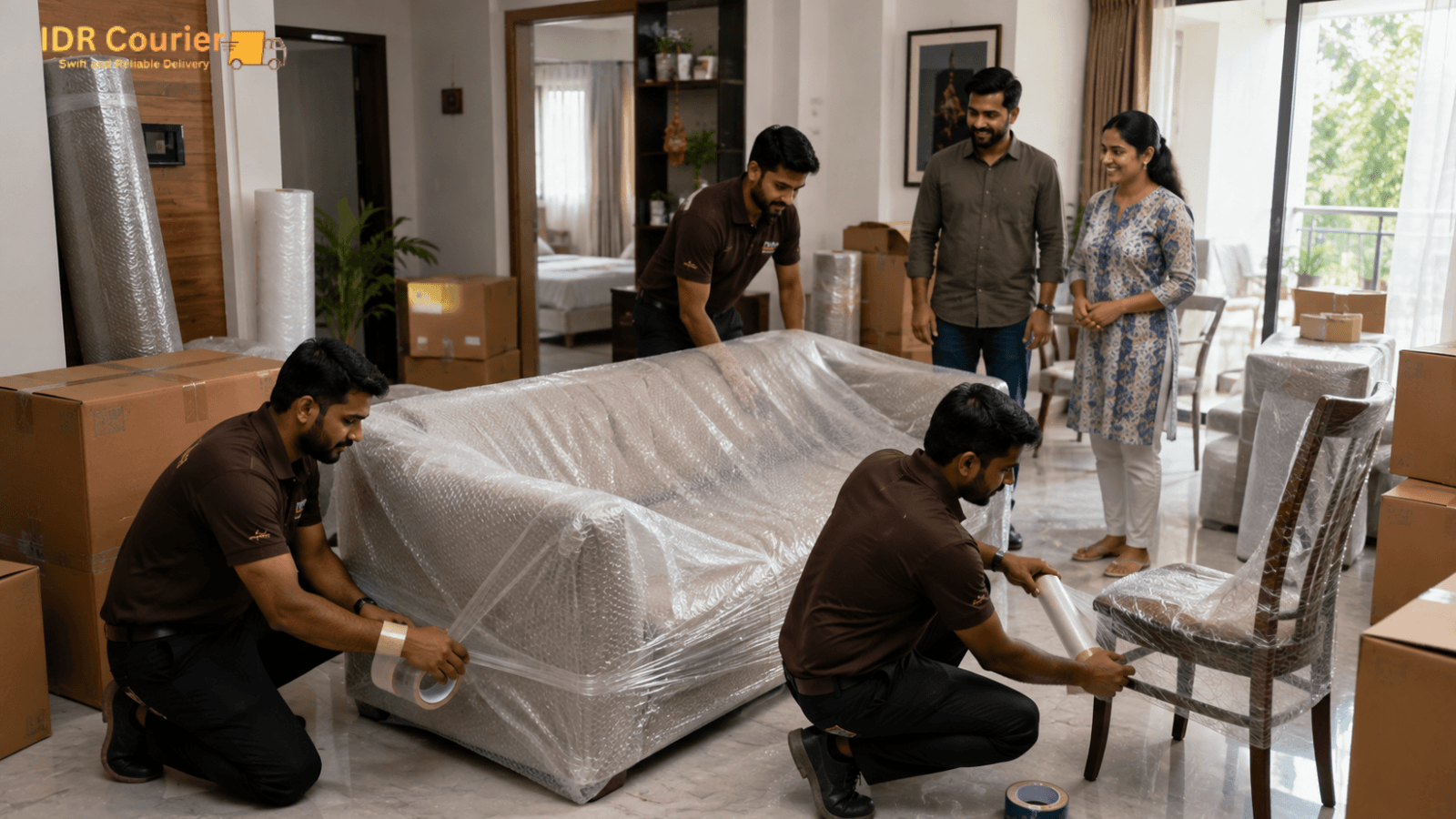
Doorstep furniture pickup — inspected, packed and loaded on-site
How Furniture Pickup Works
Pickup for furniture is a more involved visit than a standard courier collection, because there's usually assessment and preparation work to do on-site before anything can be loaded. When you book, our team first asks for basic details — what item, roughly what size, ground floor or upper floor, lift access or stairs — so the visit is planned with the right number of people and the right equipment from the start.
On the day of pickup, the team inspects the item, checks for any existing damage or wear (noted on the pickup record so there's no ambiguity later), and decides whether the piece needs to be disassembled for safe transport. A dining table with removable legs, a bed frame, or a large wardrobe are common candidates for partial disassembly, since transporting them fully assembled increases the risk of damage and often simply doesn't fit through doorways or stairwells intact.
For societies and apartment complexes, this stage also includes basic coordination — checking with security or the gate, confirming lift booking timing if the building requires it for large item moves, and working around whatever access rules the specific society has in place. None of this needs to be arranged in advance by the customer; it's handled as part of the visit itself.
How We Pack Furniture for Transport
Packing happens at your address, not somewhere down the line at a warehouse. Corners and edges — the parts most likely to get knocked or scratched — are padded first, typically with foam corner guards or thick cardboard. Flat surfaces like tabletops and cupboard panels are wrapped in stretch film to prevent scuffing, and fabric items like sofas and mattresses get a protective outer wrap suited to keep dust and moisture out during transit.
Glass elements — a tabletop, a cabinet door, a mirror built into a dresser — get separate, dedicated protection, usually cardboard sandwiching with foam padding, since glass is one of the most common damage points if handled the same way as solid wood. Anything with moving parts, like drawer units or reclining sofas, gets secured so parts can't shift or swing open during the journey.
The packing materials themselves are chosen for the specific item rather than applied uniformly — a heavy wooden dining table needs different protection than a fabric sofa, and a glass-topped console needs different handling again. This item-specific approach is slower than a one-size-fits-all wrap, but it's the difference between furniture arriving in the condition it left in and furniture arriving with new scratches, dents or cracks that weren't there before.
Loading and Transportation
Loading is where a lot of furniture damage actually happens if it isn't done carefully — items shifting against each other, sharp corners pressed into softer pieces, or weight distributed unevenly so something tips during a sharp turn. Furniture is loaded with heavier, sturdier items positioned to support lighter or more fragile ones, secured with straps or rope to prevent movement, and padded wherever two items would otherwise be in direct contact.
Transportation for intercity furniture typically moves through the same route network used for cargo shipments, but with furniture-specific handling instructions attached to the consignment so it isn't stacked or handled the same way as general boxed cargo at transit points. Vehicles are chosen based on the size and volume of the shipment — a single sofa doesn't need the same vehicle as a full office relocation — and route planning accounts for road conditions where possible, since a smoother route matters more for furniture than it does for a sealed parcel.
For longer routes spanning several states, the vehicle itself is loaded once and generally not unpacked and repacked at every stop, which reduces the number of times furniture is physically handled — and every handling point is, in practice, a point where something could go wrong. Minimising those touchpoints is one of the simplest and most effective ways to protect a shipment over a long journey.
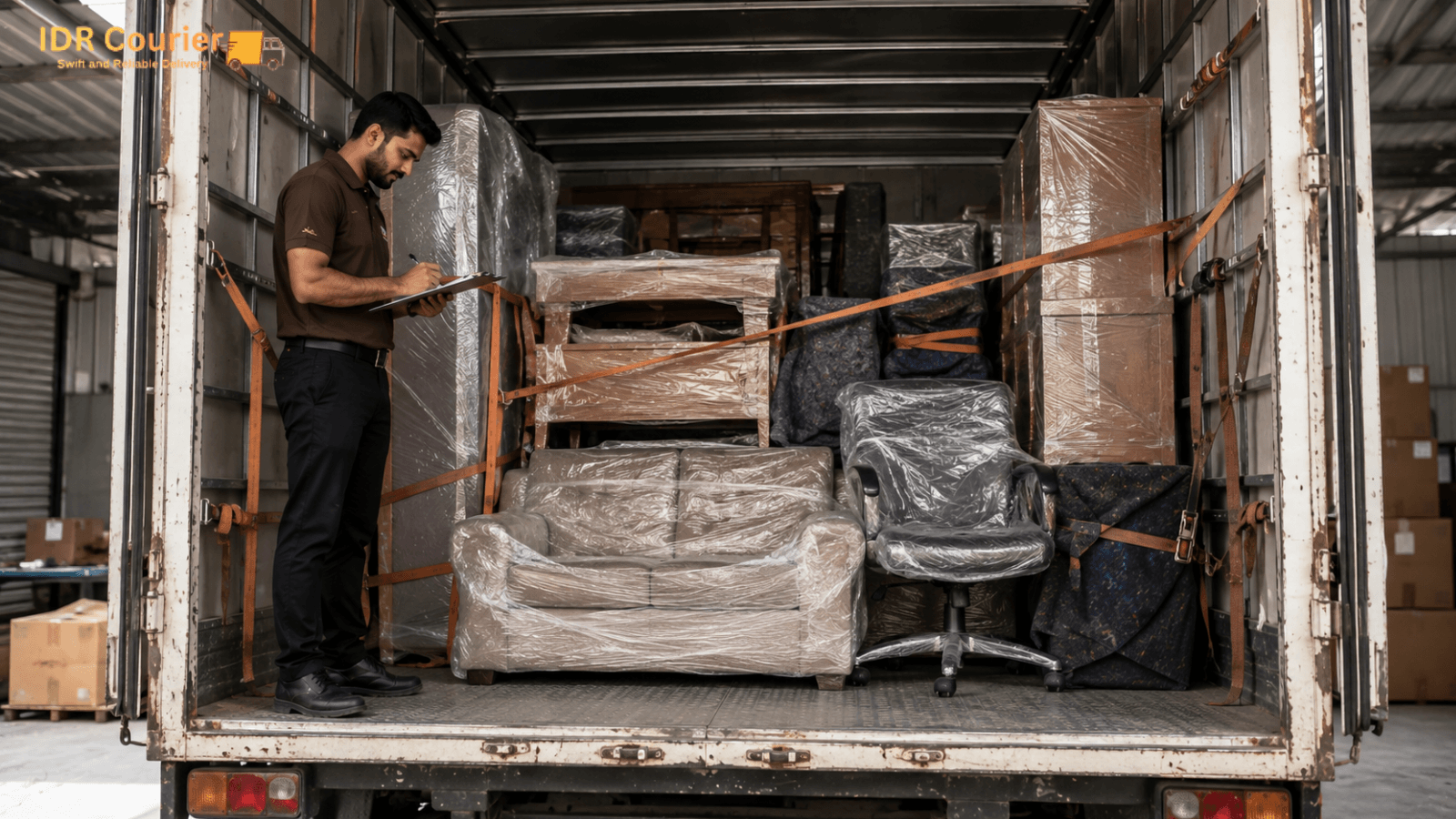
Padded and wrapped furniture secured before transport
Warehouse Handling During Transit
Longer intercity routes usually involve at least one transit point where cargo is consolidated or transferred between vehicles. At these points, furniture is kept in its own handling category rather than mixed loosely with general parcels — it's stored upright where the item requires it (sofas and mattresses, for example), kept away from anything with sharp edges or leaking risk, and moved by trained handlers rather than left for general loading staff to process along with everything else.
Where a shipment needs to wait even briefly at a transit hub before onward transport, it's stored in a way that avoids stacking anything heavy on top of furniture items, and away from areas where moisture or extreme heat could affect wood, fabric or glued joints over time.
Delivery and Tracking
On the delivery end, the same care applies in reverse. Our team coordinates with building security or society management where needed, uses the lift for upper-floor deliveries rather than expecting the recipient to arrange this, and carries the item to the actual room it's meant for rather than leaving it at the entrance. If the piece was disassembled for transport, basic reassembly is typically handled on-site as part of delivery.
Tracking begins the moment the item is collected. A tracking ID is issued at pickup, and status updates — collected, in transit, reached destination hub, out for delivery, delivered — are sent through SMS or WhatsApp so you always know roughly where your furniture is on its journey.
Delivery isn't considered complete until the recipient has actually seen and accepted the item — a quick joint inspection at handover confirms the furniture arrived in the condition expected, and any concerns are noted immediately rather than discovered days later when it's much harder to trace back to a specific point in the journey.
Quality Checks at Every Stage
- Condition of the item is recorded and noted before packing begins
- Packing is inspected before loading to confirm all vulnerable points are protected
- Loading is checked to confirm items are secured and won't shift in transit
- Condition is checked again on arrival before final delivery
- Recipient signs off on delivery, confirming the item arrived as expected
Safe Handling from Pickup to Delivery
Every furniture shipment is handled with care from the moment it is collected until it reaches its destination. Our team verifies the pickup details, ensures the furniture is properly packed before loading, and handles each item carefully during transportation. Every shipment is documented with a pickup record and tracking information, allowing you to monitor its journey. Whether you are sending a single chair, office furniture, a sofa set or complete household furniture, we focus on secure handling, careful loading and reliable Pan India delivery.
How Long Furniture Delivery Takes
| Route Type | Typical Timeline |
|---|---|
| Within the same city | 1–2 days |
| Nearby cities (under 300 km) | 2–4 days |
| Mid-distance intercity routes | 4–6 days |
| Long-distance Pan India routes | 5–9 days |
Actual timelines depend on route availability, item size, and whether disassembly/reassembly is involved.
What Determines Furniture Delivery Cost
- Weight and volume — heavier and bulkier furniture costs more to transport
- Distance — intercity and long-distance routes cost more than local delivery
- Packing complexity — glass, fragile, or irregularly shaped items need more packing material and time
- Floor access — upper floors without lift access may involve additional handling effort
- Disassembly/reassembly — items requiring this add to the service scope
Use the Rate Calculator for an instant estimate, or call for an exact quote based on your specific furniture.
Why Furniture Gets Damaged in Transit — and How We Prevent It
Most furniture damage during a move doesn't happen because of one dramatic accident — it happens through a series of small, avoidable mistakes. Corners knocked against doorframes during loading. Items stacked without padding between them, so one surface scratches another over hours of vibration on the road. Glass panels packed the same way as solid wood, with no extra cushioning for the added fragility. Straps that weren't tight enough, letting an item shift and collide with something else mid-journey.
How We Prevent It
Prevention comes down to treating each of those failure points as a specific step rather than a general instruction to "be careful." Corners get dedicated padding before anything else happens. Items are separated with protective material rather than placed directly against each other. Glass gets its own packing category, not a generic wrap. Loading follows a weight-and-fragility order rather than whatever fits first. None of this is complicated in principle — it just requires doing it consistently, every single time, rather than only when an item looks obviously delicate.
The other common source of damage is simply distance and time — a shipment moving across three or four states spends far longer in transit, and on far more varied road conditions, than a local delivery ever would. Vibration that seems negligible over an hour can loosen a joint or wear through padding over two or three days. This is exactly why longer routes get more robust packing by default, not just more careful loading — the packing has to hold up to the actual journey length, not just survive being lifted into a vehicle.
Furniture Packaging Tips Before Pickup
A little preparation on your end helps the pickup and packing process go faster.
- Empty drawers and cupboards before pickup — loose items inside can shift and cause damage
- Remove any detachable glass shelves or panels and point them out to the team separately
- Take photos of the furniture's condition before pickup for your own records
- Clear a path from the item's location to the door or lift, so loading isn't slowed down
- Mention any existing scratches, dents or wear so they're noted before transit begins
- If reassembly instructions exist (manuals, extra screws), keep them together and hand them over at pickup
Pan India Furniture Delivery Coverage
We provide doorstep furniture pickup and delivery across India. Explore our city pages below or browse all service locations.
Looking for furniture delivery in another city? View All Cities →
What Customers Say About Furniture Delivery
"Moved our full sofa set and dining table when we shifted societies within the same city. Everything was packed properly and nothing got scratched."
"Sent my study table and chair home after finishing my course. Pickup from the hostel was smooth and it reached in good condition."
"We relocated our office and needed desks, chairs and filing cabinets moved to another city. They handled it as one coordinated shipment, which made planning much easier."
"Our furniture shop uses this for customer deliveries outside the city. GST invoicing is straightforward and deliveries have been reliable."
"As an interior designer, I regularly need client-purchased pieces moved between project sites. Having a team that understands furniture handling, not just boxes, makes a real difference."
Book Your Furniture
Pickup Today
Fill the form and our team calls back with a confirmed pickup slot and price estimate.
- Free quote, no obligation
- Doorstep pickup and packing
- Live tracking from collection
🛋️ Furniture Pickup Request
Fill all fields for a quick callback.
Furniture Delivery — Frequently Asked Questions
Related Courier & Cargo Services
People Also Search For
Ready to Send Your Furniture Safely?
Doorstep pickup · Professional packing · Live tracking · Pan India delivery